



Podcast: Play in new window | Download | Embed
Subscribe: Apple Podcasts | Spotify | Amazon Music | Android | RSS
AI in optometry is opening a conversation about how doctors spend their time—and how much of that time reaches the patient. Between administrative demands, staff questions and the daily work of running an office, meaningful patient interaction can become squeezed by the responsibilities surrounding it. For optometrists experiencing burnout, greater efficiency matters most when it creates room for a more satisfying way to practice.
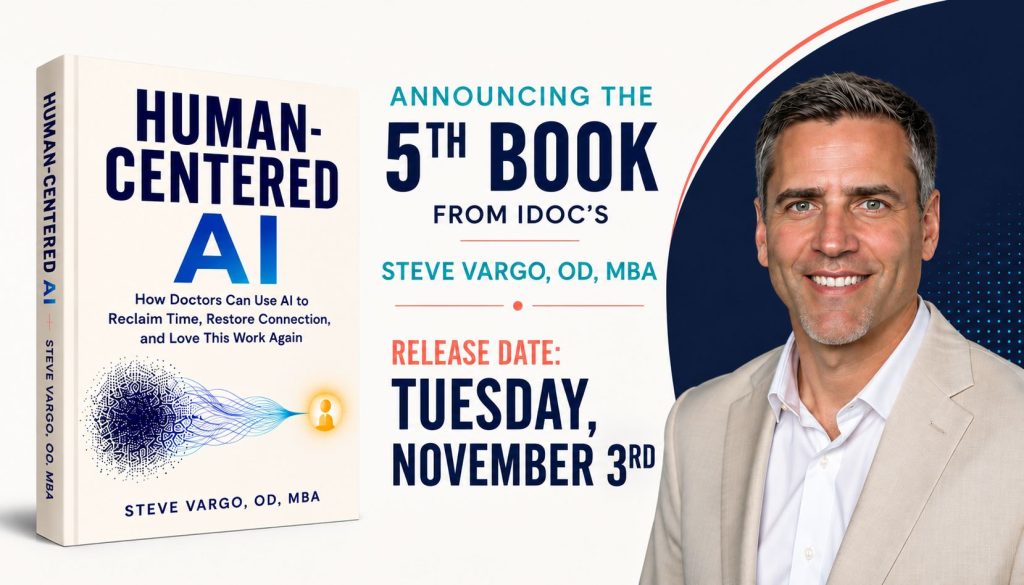
In this Defocus Media episode, Dr. Steve Vargo joins Dr. Darryl Glover to explore that connection. Drawing on his consulting experience and his book, Human-Centered AI, Dr. Vargo explains how simpler systems, accessible practice knowledge, and thoughtful technology use can help reduce operational friction. His central concern is what doctors can do with the time they recover: strengthen patient relationships, lead their teams, and enjoy life beyond the office.
Optometrist Burnout: The Work Surrounding Patient Care
For Dr. Vargo, the discussion begins with an experience he remembers clearly. After arriving at work one morning, he sat in his parking space for 10 minutes, reluctant to go inside. That moment informs how he approaches doctors who are struggling. A conversation that initially appears to be about practice growth may reveal a more personal goal: finding peace, recovering energy or enjoying the profession again.
In his view, understanding optometrist burnout requires a close look at the work surrounding the examination. Administrative requirements, regulatory demands, and recurring operational problems can consume the attention doctors hoped to devote to patients. A busy schedule may be the most visible pressure, but the responsibilities layered around that schedule deserve scrutiny as well.
“You don't need to stop seeing patients,” Dr. Vargo says. “But in a lot of ways, we have to get back to patients.”
That distinction shapes the episode’s approach to AI in optometry. Technology has value when it helps clear obstacles between doctors and the work they find meaningful. Addressing those obstacles starts with understanding how the practice functions each day.
Simplifying Optometry Practice Management Before Adding AI
Dr. Vargo’s emphasis on systems predates his interest in AI. He points to successful franchises as examples of businesses built around repeatable processes. Independent optometry practices may value different freedoms and priorities, but they can still benefit from documenting how work should happen and making those expectations easier to follow.
Complexity can undermine that effort. In his consulting work, he sometimes encounters proposed processes that seem too elaborate for the small teams expected to carry them out. His preference is to simplify, establish consistency and continue refining the workflow. A procedure must be usable during a working day to become part of the practice.
This is an essential foundation for optometry practice management. Introducing another tool does little to resolve confusion if the underlying process remains unclear. The opportunity is to establish shared guidance first, then consider how AI could help staff access and apply it. That approach connects technology adoption to a specific operational need.
Building an AI-Supported Knowledge Resource for Eye Care Teams
One example Dr. Vargo describes is a centralized office knowledge resource, which he calls a second brain. In many practices, information is scattered: one checklist sits in a drawer, another document lives elsewhere, and an office manual receives little attention. Meanwhile, the owner or manager holds additional knowledge that has never been captured in a shared resource.
His proposed AI-supported system would bring those materials together so team members could ask questions, retrieve documents and find established guidance. He describes experimenting with a demonstration practice in which uploaded resources could support questions, document creation and staff learning.
The connection to burnout is practical. When the doctor or manager must answer every recurring question, routine work repeatedly competes for their attention. Making practice knowledge easier to retrieve could reduce some of that dependence. It could also make written procedures more useful by bringing them into everyday decisions.
Dr. Glover connects this idea to consistency across the eye care team. Patients interact with several people during a visit, and conflicting explanations can create frustration. A shared source of guidance offers a way to support clearer communication from the front desk through the exam room and optical.
Using AI to Strengthen Patient Communication
Beyond organizing information, AI in optometry can provide a space to prepare for challenging interactions. Dr. Vargo describes using it as a strategic thought partner, with the person directing the exchange and retaining responsibility for decisions. The goal is to test an explanation, uncover unanswered concerns, and improve communication before entering the actual conversation.
For example, a doctor preparing for a difficult patient discussion could ask AI to take the patient’s role and respond to an explanation. The doctor could then request feedback about what was clear, what was overlooked and where the response failed to address the concern. Dr. Vargo presents this as an opportunity for practice and reflection.
That use of AI supports the broader theme of human connection. Dr. Glover notes that different team members may explain the same issue differently, leaving patients unsure which answer to trust. Consistent guidance and communication practices could help staff approach those moments with greater alignment.
Dr. Vargo believes independent practices have an opportunity to distinguish themselves through personal relationships as technology becomes more prevalent. In that context, better patient communication is part of the purpose behind greater efficiency: recovering the attention needed to listen, explain and connect.
Reclaiming Time and Choosing a More Fulfilling Way to Practice
“What do we do when we get that time back?” Dr. Vargo asks. The question moves the discussion from productivity to purpose. A practice can become more efficient without its owner ever deciding what that efficiency should make possible. He encourages doctors to examine where their time is most valuable and what they actually want their role to include.
The answer will differ. Some optometrists want more patient care. Others want additional time to lead the business, develop their team or enjoy activities outside the practice. Delegation, staffing, virtual assistance and AI can all enter that conversation. The starting point is a clearer understanding of the work the doctor wants to keep and the responsibilities that could be handled differently.
Dr. Glover closes by encouraging colleagues to apply what they learn. For an eye care practice, one useful first step is to identify a recurring administrative burden and examine whether a simpler procedure, clearer delegation or AI support could help. Meaningful progress begins with a specific problem and a deliberate change.
Explore Dr. Vargo’s Human-Centered AI or find the book on Amazon for more on reclaiming time while keeping people at the center of care. Subscribe to Defocus Media for more conversations on optometry, practice leadership, and patient connection.

