



Podcast: Play in new window | Download | Embed
Subscribe: Apple Podcasts | Spotify | Amazon Music | Android | RSS
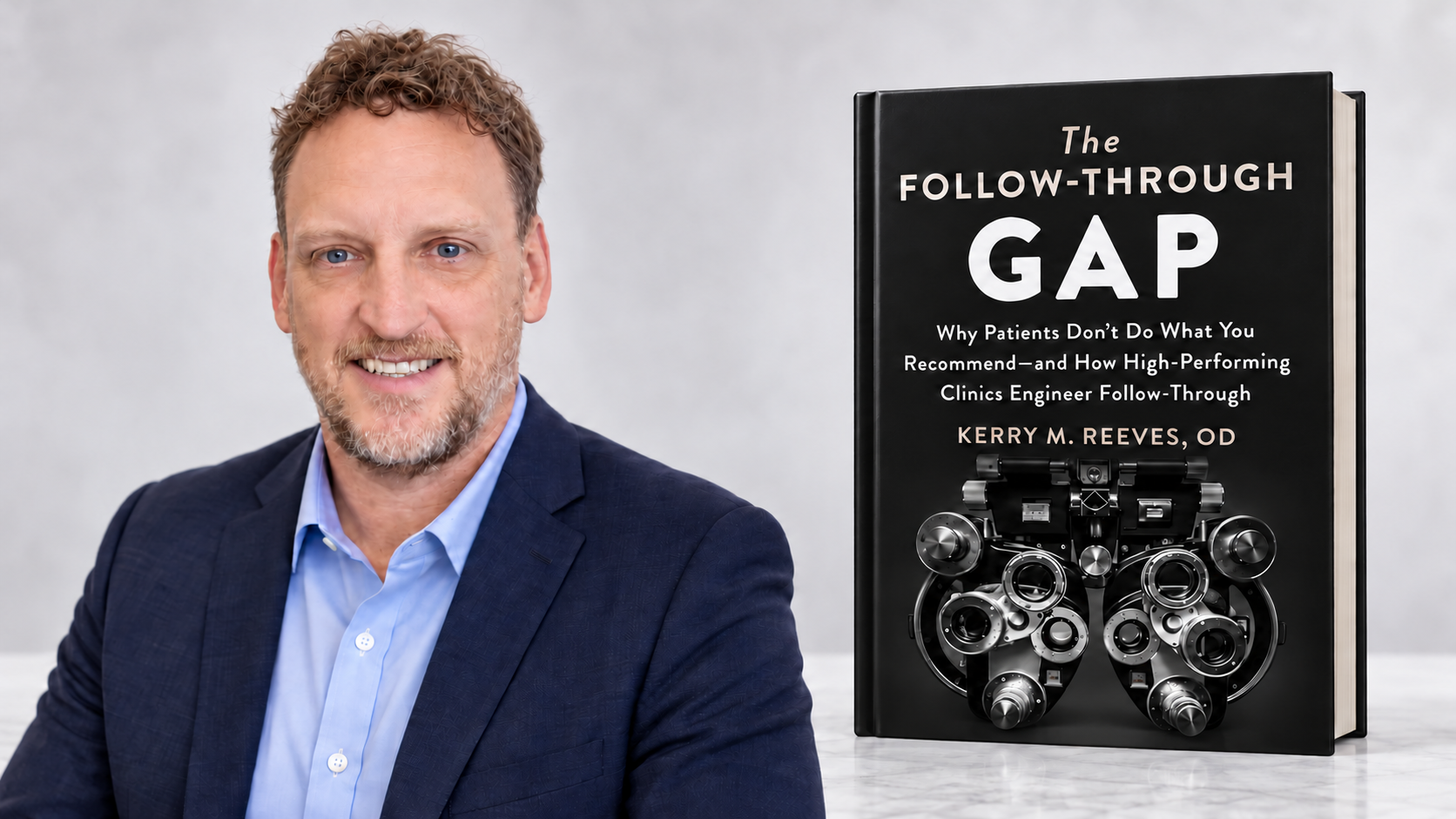
The examination ends with a diagnosis, a treatment recommendation and a patient who appears ready to act. What happens afterward is less certain. Instructions compete with work, family responsibilities and established routines, leaving a gap between the care recommended and what a patient actually does. In a Defocus Media conversation with Dr. Darryl Glover, optometrist Dr. Kerry Reeves explores that disconnect through his book, The Follow Through Gap. The discussion connects patient follow-through in optometry with the systems, communication and leadership that support care beyond the exam room.
Topics Covered:
Improving Patient Follow-Through in Eye Care
After years in practice, Reeves recognized that his recommendations were not consistently producing the outcomes he wanted. That realization prompted him to examine how his clinics could better help patients carry out treatment.
“A recommendation is not a care plan.”— Dr. Kerry Reeves
Suggesting warm compresses and artificial tears identifies a treatment, but does not necessarily establish how it will become part of someone’s day. Glover brings that distinction into everyday patient communication, emphasizing conversations about morning and evening routines. Understanding those habits can help doctors accommodate treatment within a patient’s lifestyle and make the next step more manageable.
Fixing Recurring Problems in Optometry Practices
Reeves’ understanding of systems developed partly in Haiti, where he served as a medical missionary and helped with rebuilding efforts after the earthquake. During a fishing trip, his friend Roger saved dead bait fish in case his children needed them for dinner. Although they caught two large sailfish, finding a buyer proved difficult. Their effort had produced a catch without resolving the larger problem.
That experience informs the approach explored in The Follow Through Gap by Kerry Reeves. Within an eye care practice, recurring interruptions, missed appointments and patients who do not return can reveal weaknesses in supporting processes. His recommendation is to choose one repeated frustration and trace it backward. A bottleneck, unnecessary friction or missing feedback may be sustaining the same outcome.
Strengthening Optometry Team Leadership and Patient Communication
Understanding those problems requires perspectives from across the practice. Scheduling, testing, examinations, eyewear selection and follow-up involve different people, each encountering a different part of the patient journey. Reeves encourages straightforward conversations about what keeps happening, why it happens and what could change. Doctors must examine their own contribution as well; sometimes, he acknowledges, the doctor is the bottleneck.
Glover connects this responsibility with the need for leadership preparation during optometric education. Reeves likewise encourages professional development beyond clinical knowledge, describing four areas of growth: mastering yourself, leading people, building systems and scaling the organization.
Building Better Systems for Sustainable Eye Care
As practices grow, their supporting processes must evolve. Drawing on his experience raising eight children, Reeves explains how expanding responsibilities require changes in communication, finances and daily routines. The same principle applies when a practice adds patients, staff or locations.
For him, dependable systems also create room for family by allowing the clinic to function without his constant presence.
“Hope’s not a system.”— Dr. Kerry Reeves
The practical challenge running through The Follow Through Gap begins with the next patient encounter: consider whether the patient is leaving with advice alone or a care plan they can realistically follow.

