
Podcast: Play in new window | Download | Embed
Subscribe: Apple Podcasts | Spotify | Amazon Music | Android | RSS
In this OptoCribs segment of the Four Eye Professor podcast, Dr. Randy Charrier breaks down how Heidelberg Engineering’s ANTERION® has streamlined the scleral lens fitting process. By using swept-source OCT technology, practitioners can replace manual guesswork with objective, micron-level data. Host Dr. Chris Lievens joins Dr. Charrier to discuss how this technology, paired with efficient clinical systems, secures better outcomes for patients with complex corneal disease.
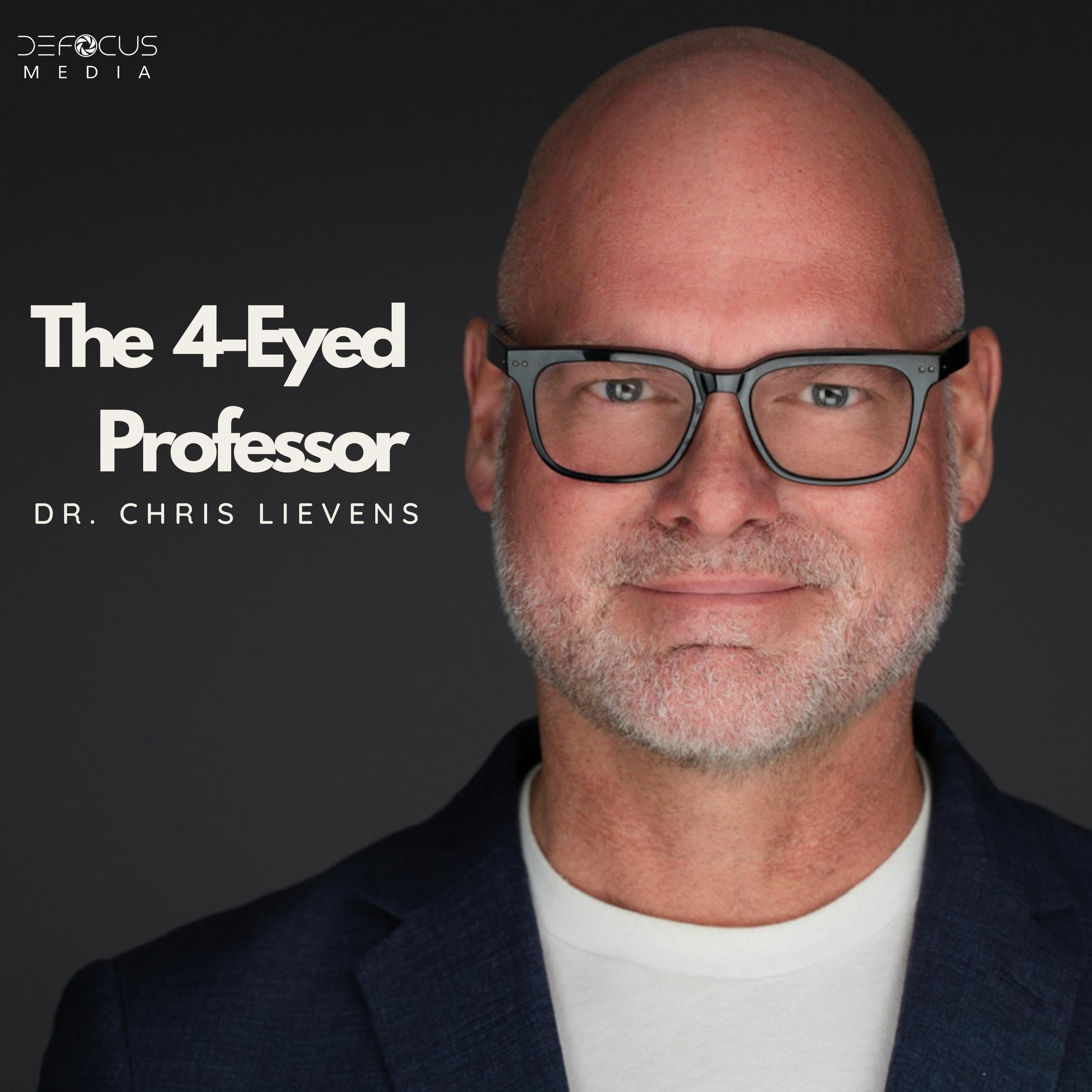
Table of Contents
The Evolution of Scleral Lens Fitting: From the Navy to Private Practice
Scleral lens practice has shifted from a niche “last resort” for trauma to a primary medical intervention. Dr. Charrier’s expertise was forged at the Naval Medical Center in San Diego, where he managed extreme corneal trauma and advanced keratoconus. Seeing the impact of these lenses in a high-stakes environment taught him that specialty fits are about restoring function, not just checking boxes.
Today, Dr. Charrier emphasizes that a successful practice is not built on a doctor’s intuition, but on repeatable clinical systems. This approach enabled him to relocate his practice 40 miles and maintain a near-100 % patient retention rate. Patients followed the system and technology, which delivered consistent, predictable results year after year.
Professional Tip: Framing the Conversation
To manage the “chair time” often associated with sclerals, Dr. Charrier uses mindset screening. Before the patient enters the exam room, staff identify if the patient is seeking “perfection” or “improvement.” By framing the lens as a medical treatment for a disease—much like a steroid for uveitis—you shift the patient’s focus from a retail purchase to a necessary clinical intervention.
The “Underpromise” Strategy for RK Patients
Managing expectations is a vital clinical skill. For Radial Keratotomy (RK) patients struggling with night glare, Dr. Charrier is upfront about what the lens cannot fix. By setting realistic boundaries early, any visual gain becomes a clinical “win,” leading to higher satisfaction and fewer unscheduled follow-ups.
Why the ANTERION is Essential for Specialty Fitting
While slit-lamp assessment is a core skill, Dr. Charrier identifies the ANTERION as the most significant advancement in his career. It provides a level of quantifiable data that makes the fitting process more efficient and much less cumbersome.
The Physics of Swept-Source OCT
The ANTERION utilizes swept-source OCT technology. Unlike older spectral-domain OCTs, swept-source uses a 1300nm wavelength that penetrates deep into opacities.
The Index of Refraction Secret: Standard OCTs assume the first surface they hit is the cornea. However, a scleral lens has a different index of refraction than the eye. The ANTERION compensates for these different indices, providing exact measurements of the vault and the posterior corneal surface through the lens. This is critical for monitoring corneal health and ensuring proper oxygen transmissibility during wear.
Deep Dive into the Modular “App” Workflow
The ANTERION operates through specialized “Apps,” providing multiple diagnostic tools in a single footprint.
Imaging App: Visualizing the Landing Zone
The Imaging App captures a full 360-degree, 16.5 mm radial scan. This is critical for identifying:
- Superior-Nasal Compression: Areas nearly impossible to see at a slit lamp but primary causes of discomfort.
- Total Vault Visualization: A complete view of the lens-to-cornea relationship across the entire surface.
Cornea App: Mapping the Epithelial “Masking” Effect
This app provides topography and tomography, which is vital for early diagnosis:
- Epithelial Maps: Shows where the epithelium is thinning to “mask” underlying stromal irregularities.
- Earlier Ectasia Detection: Identifies keratoconus months or years before it would appear on a standard topographer.
Cataract App & The “Refractive Surprise”
The ANTERION Cataract App uses 1300nm swept-source OCT to provide highly reproducible axial length measurements, crucial for IOL power calculation accuracy.
The Cataract App provides axial length biometry, which helps solve complex clinical mysteries:
Clinical Case Study: The -19.00D Over-Refraction Dr. Charrier highlights this technology through a case involving a patient with a 50-diopter cornea and a staggering -19.00D over-refraction. The ANTERION revealed a massive axial length and a clear posterior staphyloma, providing the clinical “smoking gun” to explain the visual limitations. By verifying the visual axis rather than relying on “blind” data, the app mitigates refractive surprises in highly myopic or post-refractive surgery eyes.
The Business of Specialty Lenses: Systems Over Chance
For students and practice owners, Dr. Charrier stresses the importance of checklists and delegation. Relying on staff to “guess” what the owner would do is a common pitfall. Instead, a checklist for every step of the patient journey—from the first call to the final dispense—ensures that the quality of care remains identical for every patient.
"If you don’t have a system, you are just relying on chance. Systems build confidence with the patient." — Dr. Randy Charrier
The future of optometry lies in the integration of high-level technology and robust clinical systems. By utilizing the ANTERION, practitioners can reduce refits by identifying landing zone issues on day one, build patient trust through high-resolution imaging, and ensure consistency across their entire specialty lens patient base.

